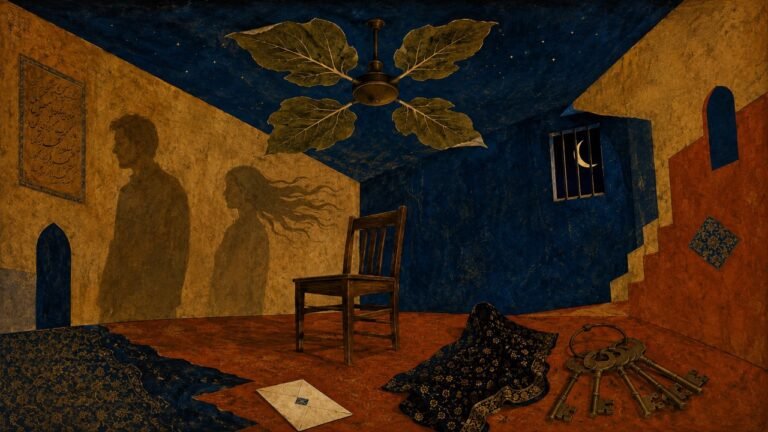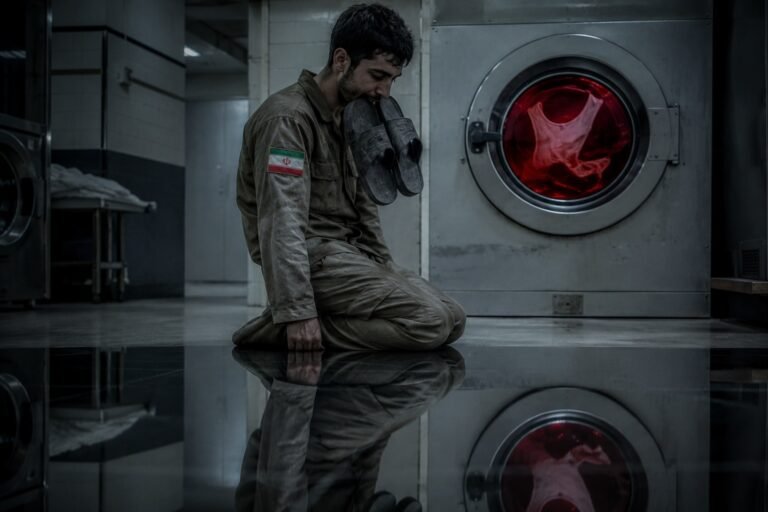
Khanum sat motionless in her wheelchair – the one her cousin had sent for her – in the long, dark corridor that stretched from the back courtyard at one end to the cold room at the other, where large refrigerators were kept. The heavy sliding door of the cold room was black.
No one knew what went on inside. Whenever the door was to be opened, everyone in the building was required to remain in their own rooms; failure to do so brought severe punishment. Even the nurses were forbidden to be out of their rooms. A special guard stood behind the door to protect the cold room while it was being opened or closed.
Only one of the nurses had ever seen what was going on in the room, quite by chance, on one of the CCTV cameras. She had noticed it when the condition of one of the attendants had suddenly worsened and they had asked her, one of the best nurses, to go to the security room, and the guard had failed to switch off the last camera.
Human beings are always less capable than they imagine in controlling every aspect and factor involved in any matter. Consider writing, for instance: no matter how many times you endure the agonising labour of editing, there will always be an editor other than yourself who will notice points that have escaped your eye.
But let us move on. You may wish to know more about this nurse and the room in question, yet for now I cannot tell you a great deal. All I can say is that the nurse’s name is Mahvash, and she has won the confidence of an elderly lady to whom she has become a trusted confidante. It was this closeness that led the old lady to give her a considerable sum of money in exchange for a full account of what she had glimpsed through the CCTV camera.
The nurse, who addressed the old lady simply as ‘Khanum’, without using her surname, had even told her that steam had been rising from the half-open door. Since everyone in the building knew the room as the cold room, the vapour was presumably caused by the chill air within.
‘Khanum, I’ve had your room tidied. I put that little photograph back above the mirror.’
‘Photograph?’
‘Yes, the one you once said you were very fond of.’
‘The photograph of my mother?’
‘No, ma’am. The one of the gentleman with the terribly frightening moustache.’
‘Moustache?’
‘Never mind, Khanum.’
‘You always say “never mind” when you have no answer for me.’
‘Perhaps. Your questions are difficult, after all. Is there anything else I can do for you, Khanum?’
‘Why is it so dark here?’
‘You’ve asked that question more than a hundred times already.’
‘No, that is not true at all. Why do you talk nonsense? This corridor was bright this morning.’
‘It is not yet noon, Khanum.’
‘Ah, so why did I think night had fallen?’
‘It happens sometimes, Khanum.’
‘What happens?’
‘That one loses track of time.’
‘Presumably one finds it again afterwards.’
‘I’m glad to see you laughing.’
‘You say such funny things. What does it mean, to lose track of time?’
‘It means one is so absorbed in thought or occupied with something that one forgets what time it is.’
‘Very well, suppose it is not night. Why does it remain as dark as those unlit houses?’
‘On account of the power shortage; they turn the lights off.’
‘Power shortage?’
‘Yes, and sometimes because of the bombing.’
‘Is there a war going on?’
‘In a manner of speaking.’
‘You’re in a joking mood today, but I have no patience for it.’
‘Khanum, it is time for your medicine. Should I bring it or will you go to your room?’
‘I feel upset. I cannot face that wretched room.’
‘Then I’ll bring them to you.’
The nurse went to fetch the old lady’s medicines.
Khanum’s gaze, empty now of hope or gladness at her age, remained fixed at the great black door of the cold room. She had once longed intensely to understand the secret of that fearsome place, but now she simply stared at it, often for a very long time, without even remembering that longing. Whenever they tried to turn around her wheelchair and her back was to the black door, she would protest loudly and angrily.
Once, when her cousin, who bore all her expenses and had come to visit, noticed the staff turning the chair. ‘Do not torment her,’ she shouted at them sharply. ‘let her be. Have you nothing else to do but move this poor woman’s wheelchair?’
The nurse returned with the medicines. One by one she took them out and gave them to the old lady. Each sharp click as a pill came free of its blister sent a faint, almost imperceptible tremor through Khanum’s spirit, if not through her body. There is a sound to being uprooted.
There are sounds that echo through the roots of our being. Sometimes we hear them and grow anxious. Other times we hear them and pretend we do not. Sometimes we strive to drown them out with other noises. And in the end, often because our hearing will fail us, we do not hear them properly at all.
Zari Zarrab, or rather the old lady who appears to be the protagonist of our tale, though in truth she is the central character of a life nearly spent, had heard these sounds many times. Perhaps the faint tremor caused by the pills came from her familiarity with the bitterness of just such clicks of parting.
‘Khanum dear, I have good news,’ said the Nurse as she handed Khanum another pill.
‘I’m not taking that,’ said Khanum. ‘Every time I take it, it leaves me dizzy and befuddled.’
‘Khanum, this is the important one. You must take it. Wouldn’t you like to hear the good news?’
‘Good news?’
‘Yes, it will certainly cheer you.’
‘Cheer me up?’
‘I am certain of it! You’ll be delighted when you hear.’
‘Tell me what it is you want to say.’
‘First take this last pill, then I shall tell you.’
‘I said I will not take it.’
‘Oh Khanum dear, what is this game you play every time with the last pill!’
‘The last one?’
‘Yes. I deliberately save this one for the end because I don’t want to start arguing with you.’
‘Did you know I have always been afraid of the end of things?’
‘The end of something happy holds no fear!’
‘A happy ending is still an end, is it not?’
‘Everything has an ending.’
‘That is the very tragedy.’
‘There now. Take your pill and then we shall talk.’
‘Why do you always want to send me to sleep?’
‘The doctor prescribed these medicines.’
‘What is wrong with me? Why do you shove so many drugs into my mouth?’
‘Back to square one!’
‘Better than the last square.’
‘Khanum, the days of your poetry are behind you, though I must say, one of your poems is very beautiful.’
‘My poems?’
‘Yes, the one with the witty play on “Shah” and “Khosrow.”’
‘Khosrow?’
‘Yes. In it, you teased the Sassanid kings, Khosrow Parviz, in it.’
‘I did?’
‘Yes, Khanum: “Khosrow who was no king and wore no crown; Parviz captured the land and placed his crown upon his head.” Now please, I beg you, take this pill so that I may give you the good news.’
‘Very well.’
‘Bless you. And now the good news: tonight your cousin is putting on a special performance of a play for the residents.’
‘My cousin?’
‘Yes.’
‘Well, that is nice.’
‘Are you not pleased?’
‘I suppose I am.’
‘Excellent. Now go and rest so that you will be fresh for the evening.’
‘Let me stay a little longer, then I’ll go.’
‘Very well, but only a short while.’
‘Yes, short, very short.’
The nurse left the old lady and walked out of the dark corridor. Khanum stared once more at the great black door of the cold room. After a short time the nurse returned and wheeled the old lady, who had slipped into unconsciousness in her chair, back to her room.
That evening, when it was time for the play, the nurse came to fetch her. Posters for the performance lined both sides of the hall, showing the face of a young man with a thick, masculine black moustache. The name of the play was ‘Khosrow Khan’. The elderly ladies were seated on the left side of the hall and the gentlemen on the right.
Khanum entered in her wheelchair. Everyone, including one or two of her friends and some who rose with difficulty, stood and applauded her and her cousin. Khanum did not quite understand what was happening. Before stepping onto the stage, her cousin called the old lady’s special nurse and asked her to keep a particularly close eye on Mrs that evening.
When the nurse asked whether something special was going to happen, the cousin emphasised that she had already spoken to the doctor so that everything could be monitored. When the nurse asked what the matter was, the cousin said that the story of the play is related to Khanum’s own life. Then she hurried to her place on stage.
A fresh round of applause filled the cold, soulless hall of this new, modern home for the elderly, with warmth and animation. It was as though even the bricks of the building had begun to dance. Some of those present laughed for no reason, others had tears in their eyes for no reason, several of the ladies, in a surge of emotion, embraced the person next to them.
I do not know how many of you are fond of the state of ‘no reason’, but I love that moment of emancipation from the bonds of the reasons and the constraints of logic. That state of suspending in emptiness is a trance-like state that steals your reason and entrusts you, with quiet confidence, to your ‘self’, in other words, delivers you to your heart.
Of course, I see no boundary between heart and ‘self’. You must have heard the expression ‘brain death’, but has anyone ever spoken of ‘heart death’? True, we have cardiac arrest. Yet when brain death occurs, so long as we can prevent the heart from stopping, that kind heart, your very ‘self’, permits the removal of organs and their transplantation into another.
Khanum’s cousin began the play with a monologue:
‘My dear friends, tonight’s story concerns a young man named Khosrow Khan, a gentleman from an old neighbourhoods of Tehran. This good-natured man falls in love with the girl who lives down the alleyway where he lives. The girl’s name is Zari. But a tragic event makes it impossible for the two ever to be together. Years later, when Khosrow Khan learns at the age of sixty that his beloved is living in a nursing home, suffering from memory loss, he comes and takes a job there as a servant. The girl of our story, after a car accident in which she lost her family, has stopped speaking to anyone, and in time she too develops the illness of forgetting. Whenever Khosrow Khan can slip away from his duties, he comes to see Zari, but Mrs Zarrab, our Zari, pays no attention to his presence. Khosrow decides to imitate the behaviour of those who have Alzheimer’s.’
‘Don’t push that table so close to the window.’
‘To what?’
‘The vent.’
‘You didn’t say vent. It was something else.’
‘What was it?’
‘I don’t know, but it wasn’t a window.’
‘Then if I didn’t say window, what did I say?’
‘How should I know, my lady? I only know it wasn’t a vent.’
(As she spoke these words, the audience, noticed the actor playing Khosrow Khan turn his back to Zari and wipe his tears with the back of his hand.)
‘What is the matter with you? Why are you talking such rubbish?’
‘They say…’
‘Ah, I understand. You have Alzheimer’s.’
‘Did I say that?’
‘Yes. You said it yourself.’
‘Why do you put words in my mouth, Khanum? I don’t even know how to pronounce that word.’
‘What word?’
‘This forgetting illness.’
‘Forgetting?’
‘When did I say forgetting?’
‘Then what did you call it?’
‘Anzymer.’
‘What?’
‘Forgetting, my Khanum.’
‘Goodness! I am not your Khanum!’
‘Sorry.’
‘You really do have Alzheimer’s.’
‘Yes, I think I have Anzymer.’
‘What do you have?’
The actress playing Zari gave a little laugh that seemed to carry into the other rooms: ‘Forgetting illness, of course.’
The narrator reappeared on stage and continued her monologue: ‘Little by little Zari becomes attached to Khosrow whose task is to take the bodies of those who have died in the home to the building’s temporary mortuary until they can be transferred to the cemetery behind the building or to other resting places. But every time Khosrow Khan has to pass through the black door of the cold room, everyone must stay in their rooms, including Zari. Until one day Zari pretends to be asleep; her special nurse, thinking she has taken her medicine, leaves the room. Zari slips out and sees what she should not see.’
‘Khanum, what are you doing here?!’ The actor playing Khosrow asked the actress playing Zari in alarm.
‘Don’t touch me.’
‘I only touched your wheelchair.’
The scream of the actress playing Zari rang through the hall: ‘I said don’t touch me!’
‘Very well.’
‘Don’t touch me, you wretch!’
‘I said very well, my dear.’ ‘
What have you done with that person?!’
‘I swear, Zari, it is not my fault.’
The actor playing Khosrow began to sob uncontrollably. The nurse appeared on stage and took the old lady back to her room.
The narrator continued her monologue: ‘From then on, Zari refused to see Khosrow until the day he himself died in that same nursing home and was taken to the cold room. Once again, like the previous occasions, Zari secretly witnessed the event.’
The play continued until the actors playing Khosrow’s friends, Mehdi and Javad, appeared on stage to carry his body. At that moment Khanum felt unwell and a nurse quickly wheeled her out of the hall. Her cousin joined them in the courtyard.
‘Are you all right, my dear?’
‘What?’
‘I asked if you are feeling better.’
‘Yes, only take that black cat and her kittens away from here. Khosrow is cruel to the cats because of his pigeons.’
‘Who, my dear?’
Her cousin asked the question with tears welling in her eyes.
‘Take me inside the building.’
The nurse guided Khanum back into the long, dark corridor that stretched from the back courtyard at one end to the cold room at the other, where large refrigerators were kept.
Khanum asked the nurse to leave her there alone. Then for hours she stared at the black door of the cold room.