
My name is Reza, or perhaps Mohammad. Call me Mohammad Reza, it’ll do. My trade and occupation is business, not commerce exactly; well, let both of them go to the devil. Think of me as the house singer at Café Kolbeh. How old am I? Fifty-odd years! My identity card says the twenty-sixth of Azar, eleven sixty-six. My employer is a wretch, this Issy the Bluffer I’m talking about, this Kazeruni. I signed a couple of promissory notes for him, lest I might one day find a better place with better pay and do what he calls “let the elephant remember India” and slip through his fingers.
Lord, deliver that corrupt, Godless man his dues with your own hand. Three years I’ve been singing, all of it here, in Café Kolbeh. How fast life goes, faster than an Arab stallion. Don’t look at my salt-and-pepper hair; may God blacken the face of that man whose torment has turned even the dark of my eyes white. How people change. There was a time when this same Issy the Bluffer used to beg me to come and sing in his café. The moment I handed over those promissory notes I became his slave. You know that woman who at the end of days will strike the Imam with a pestle? That’s Issy the Bluffer, with that beard of his and those womanly airs. Sharp-tongued wretch, may coal dust fall on his head.
In the early days, two songs from such-and-such a singer I performed at the end of the month, and it covered my rent and my food. Since Smoky-Beard came on the scene, ten hours a day singing barely keeps me alive. And the rent has gone through the roof. In those days five hundred tomans a month and we lived like kings. But now? Lord, have mercy on your servants!
This bed is so hard my back has gone stiff as a plank. Lord, how long must I stay in this prison? Kill me and be done with it. I’m not ungrateful. Deep down I say it again: a hundred thousand thanks, Lord, for what you’ve given and what you haven’t. At least here there are three meals a day and a free place to sleep.
Yes. I was on my way to perform at the wedding of one of those friends (Issy the Bluffer himself, that’s who) and I went to Shiraz. But after the ceremony they didn’t pay me and kicked me out. I had no money, so I stayed in Shiraz and began singing for a café owner by the name of Hassan Shalu, and I gave up any thought of going back to Bushehr. Because the people of Shiraz loved art, and I had a warm voice, business flourished. Hassan Shalu went to meet his maker two years later, and I married his widow, who was of Arab origin and had a house of her own, and for several years I sang and grew more famous by the day and things went well. All of it owed to the music-lovers of Shiraz.
I had a good ear and a good memory; I would hear a song once and learn it, and with a few touches of my own I’d perform it. Over time I became skilled at warming up a gathering, weddings, cafés. People in those days married often. There was no household that hadn’t once rung with the sound of a wedding or a birthday party in all its splendour. On Friday nights, of twenty or so villas in Qasrdast, fifteen of them would have a celebration going. Nowadays, there are too many singers, lift any stone and you’ll find ten of them under it. But I’ve wandered off the subject and given you a headache, haven’t I. You were asking how I ended up in this prison?
This story has a long history and I’m afraid I’ll only make your head hurt more.
I beg your pardon? You’re quite sure?
Very well then, now that you want to the story, i’d tell you. In our very own neighbourhood there was a grocer, the most peaceful man alive, and no one until that day had ever heard Haj Amir raise his voice. I had spoken to him a few times on the way home or when shopping, and from his mouth I had heard nothing but the remembrance of God. Whenever I saw him his lips were moving in prayer. In the mornings he rode his bicycle to his shop, and in the afternoons at prayer time he lowered the shutter and stood in the front row of the congregation at the mosque.
On Friday evenings Haji Amir went to the shrine of Shah Cheragh, and returned around midnight on that same bicycle, with a great bunch of keys hanging from his trousers, as if he were the keeper of heaven’s gates. No one had ever heard a sound of revelry or quarrelling rise from Haji Amir’s house. Everyone knew the Haji had both a wife and children. I had heard he had a single daughter, and as chance would have it, one day she fell ill. He had vowed that if she recovered he would hold a celebration on the Prophet’s birthday and invite all the neighbours, and that he would continue these celebrations for a year. The daughter recovered, by the grace of the Prophet, peace be upon him, and because Haji Amir was my neighbour he extracted a promise from me that I would come and sing Mawludi songs in praise of Prophet at their celebrations throughout that year. He siad he’d pay in advance. I told myself it wouldn’t do to refuse a neighbour, and perhaps it might be a reason for God to forgive me a measure of my sins.
And I remember it clearly: on the night of Imam Hadi’s birthday I sang a beautiful Mawludi and everyone clapped and sent blessings and then we ate some sweets and sherbet. I was about to leave when behind me a voice so soft it might have come from paradise stopped me where I stood.
“Agha Mohammad Reza.”
I turned and saw a woman in her prayer chador, a packet in her hand, and from beneath the chador she extended it towards me. I realised it was money and thought the Haji has already settled up.
The girl said: “My father said I should give you this packet too, for good fortune and for my health.”
I reached out to take it. My face had gone red as a beetroot, a strange trembling had taken hold of my hand, and the packet slipped from my fingers and fell into the garden, coming to rest under a fig tree. The girl bent down to pick it up, and as she stooped she stumbled and her chador fell from her head, and there she was, bareheaded, and God forgive me, since she hadn’t been dressed for company and had let her hair loose for the celebration, she covered her face with both her hands, which had gone even redder than mine with shame.
All at once it was as though the sun had blazed directly into my eyes. My heart hammered with the force and rhythm of Abdo Siah’s Bandari beat, and without waiting for the packet I leapt out of the house and leaned against the marble wall outside and stood there for some time in a wretched state. When I recovered enough to walk, although I had two more birthday gatherings and a wedding still ahead of me and the sun had only just set, I felt so ill that I went home instead.
My wife was a good woman, and the moment she saw the state of me she said: “You’ve caught a chill. Come, I’ll make you some hot mint tea and you’ll feel yourself again.”
But I didn’t feel better at all. My mind kept drifting back to the Haji’s house and his daughter, the fig tree and that loose hair. I knew the Devil had his foot on my throat and wasn’t letting go; perhaps he was saying, you burnt soul, eating your supper under my roof and pining for someone else? Or some such thing. To be honest, in all those years, wherever I had sung, it had been at feasts and celebrations and merriment, and now I was ashamed before God and forsaken by the Devil alike. I was embarrassed before my wife too, but I opened the subject and asked:
“Do you know Haji Amir’s wife?”
“Yes, a months ago, when the news came of her sister’s death in Gonaveh, the Haji held a memorial gathering and I went along just to show my face and offer condolences. That was the first time I saw the Haji’s wife, and after that I saw her twice more at the shrine of Shah Cheragh.”
“And the Haji’s daughter?”
My wife looked at me strangely: “There’s something wrong with you tonight. What do these questions mean? What business is it of yours whether I know Haji Amir’s wife and daughter?”
“Wife, you know better than I do that the Haji has asked me to sing Mawludi for a year for the sake of his daughter’s recovery. I wanted to know how old she is, so that I can choose a suitable Mawludi for the occasion.”
“The girl must be sixteen by now. Mashallah, she’s a beauty, growing up in the Haji’s household!”
“It doesn’t concern me if she’s the moon or a star,” I said, as once again the fig tree and that hair came before my eyes. A painful sigh tore itself from somewhere deep inside me, and my wife, seeing my state, muttered something under her breath, then brought supper and ate it, and with that tongue of hers, sharp as a viper’s bite and a scorpion’s tail, she loaded me with a few choice insults and went to sleep.
My heart was seething. My wife, lying there just as she was, without opening her eyes, mumbled half-asleep: “The cats are at it again. It must be autumn.”
She was right. Two cats had been yowling at each other since the afternoon, when I left for Haji Amir’s house, and again I thought of autumn and cats and the Haji’s daughter’s hair. My heart set up such a hammering I was afraid its sound might wake my wife, and then God save us from the scandal of it.
Sleep didn’t come. I looked at the clock on the wall: it was around four in the morning. My wife was asleep, so exhausted she might have been dead, unmoved even by the beating of a drum. I pulled on a pair of trousers and a shirt, barefoot and bareheaded, and went up onto the roof. The neighbours were all deep in sleep, not a sound from a soul. The moon had taken possession of all Shiraz, and the walls and rooftops shone as though they were mirrors, and the dome of Shah Cheragh in the distance had the look of a sorrowful egg, its two minarets gripping it like a pair of fingers. One of the two cats from earlier bolted between my legs and vanished. A few alleyways away came the sound of Ibrim, who’d had a few too many, singing a song: No heart has bled like mine, no heart has known weariness and spite like mine!
From the mosque came the cry of Azan, and shattered my reverie. Then lights came on in neighbours’ houses one by one followed by the sound of coughing, then hawking and spitting; farther off, the cry of a infant startled, as if frightened by the name of God, and behind it the child’s mother, who was crooning and cursing the caller of the Azan, in the same breath. The stray dogs seemed to have fallen into a quarrel too, launching themselves at one another and raising a din that had no end. As for me, I was in the state of a man who has been caught short in a roadside lavatory, the bus horn on one side and the passengers hammering on the door to hurry him along.
As I came back down the stairs I was humming: For the Two dark eyes you have, for the two locks you let free!
When I got downstairs I found my wife awake, calling to me from behind the toilet door: “What’s the matter with you? Where were you last night?”
I came up behind her and said: “Wife, dont ruin my good name in front of all the neighbours like that. What’s the matter with you? I went up to the roof to say a few prayers in what little remains of my life, in hopes that God might accept my repentance.”
“May your prayers break your back. You’ve frightened the life out of me!”
Every day my condition grew worse, and I couldn’t sing like before. My wife fell into a depression on my account and stayed in bed most of the time. We sold what little we had, piece by piece, to pay for the rent and other expenses. I had no heart for singing and stopped attending every engagement except the Mawludi at Haji Amir’s house, that one since he had paid in advance. My wife’s illness worsened day by day, and one afternoon at midday prayers she met her maker and was relieved of her grief and sorrow.
From that day on it was just me and myself, alone and friendless. I took a secured loan from a bank, a thoroughly Islamic one, against the house my late wife had left me, and settled the doctor’s bill and the cost of the burial. What remained I spent, little by little, on bare subsistence.
One night, when my loneliness had brought me to the very edge of life, and I was thinking of putting an end to my wretched existence, there came a sudden knocking at the door. At first I didn’t answer, but when I saw it wouldn’t stop I went and opened the door, and there was Haj Amir.
“Mohammad Reza, my daughter’s illness has started again and her mother is very worried. I have come to ask you to pray on her; perhaps through the blessing of your breath, God will grant her health.”
I was ashamed before God. What could I say. I shut the door and turned to go back inside, then found I couldn’t. I looked at the sky and wept and begged God for the girl’s recovery. And in among all that I said a few things that were an affront to God, each one deserving a thousand years in hell. But yes, God himself knows the fault was not mine, and anyone else in my position would have done the same.
“Lord, you who created the lion’s claws like a cleaver, why did you make the deer’s body so tender? If cruelty and injustice and suffering are good things, why did you keep sending prophets, one after another, to fill the world with the cry of goodness? Why did you make me fall in love with Haji Amir’s daughter, only to afflict her with this misfortune?”
I spun out a great many such blasphemies that night, but I know God will forgive me, for I was raving.
I remained awake all night with weeping eyes until the first call to morning prayer, then stepped into my sandals and went out to enquire after Haji Amir’s daughter. I saw the Indian doctor parking his Honda bike outside the Haji’s door and rushing himself inside. I peered quietly through the gap in the door, and seeing nothing I slipped into the house. I was about to go deeper inside when a voice in my head said: you fool! What are you going in there for? To enquire after the girl? If she were well, would they be calling the doctor at the crack of dawn?
I stepped back quietly and made my way back home .
I slammed my front door shut and swore to myself that if anything happened to the girl I would never open that door for anyone again, until the corpse cleansers break it down to carry my body away. That morning passed until evening in grief and sorrow. I understood that this state would drive me to madness before long.
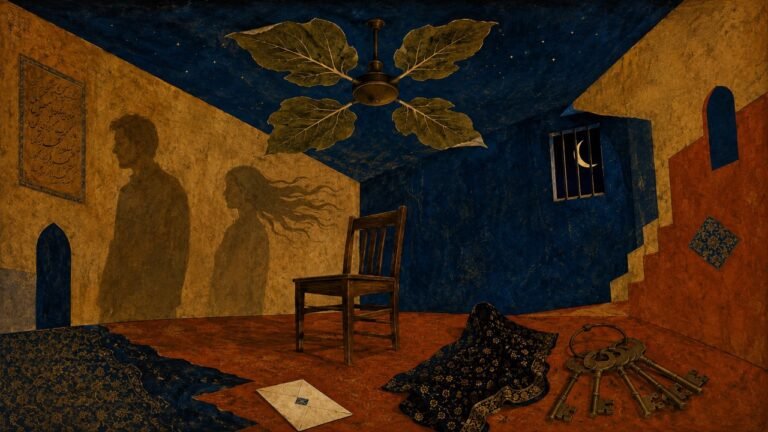
I untied the silky washing line that was stretched between two hooks in the wall, fastened it to the ceiling fan hook set into the ceiling, said my last prayer, stood on a stool and was about to put it around my neck when the door knocked. As God would have it, I jumped down and opened the door. It was Haji Amir, hammering at the door and calling my name. It transpired that the life of that flower was not meant for this world, and the Haji had come to ask me to recite the Quran at the funeral. I wanted to say I don’t know the Quran, but no sound came out, and the Haji took my silence for consent and left, leaving me alone with the shock and grief of the girl’s passing.
The moon shone in the sky. My gaze moved between the moon, in which on that moonlit night I now saw the girl’s face, and the rope hanging from the fan hook, casting its shadow on the wall in the dim yellow light. A sigh rose from deep inside me. The face a thousand times more beautiful than the moon appeared before my eyes, and I said to myself: whatever happens, I must see that full moon one more time.
I put on my sandals in a wretched state and went to the mortuary. I climbed quietly over the wall of the Hospital and into the mortuary yard, and since I had collected my late wife from that very place, I went straight to where they kept the dead. The girl lay alone on the slab in that cold room, as if she had been sleeping there for a thousand years. I recited everything I knew: prayers, the Throne Verse, poems, whatever I had. I was slowly turning to ice in the cold of the mortuary when I found my courage, stepped forward, reached out and drew back the white sheet from the face of that ill-fated girl, and bent over her to see her better.
And that was when the back of my neck went hot, and and then my head struck the edge of the slab hard from the force of a blow and I lost consciousness.
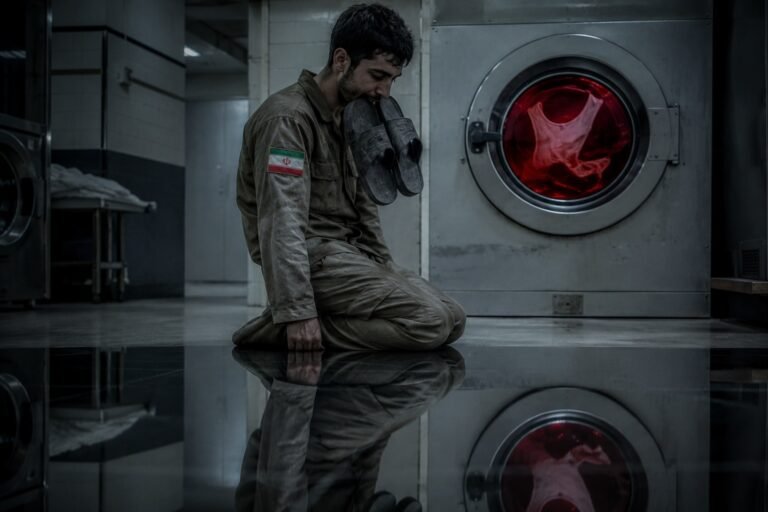
When I came round, I found myself in this windowless, lightless room. It turned out that a cleaning lady had entered the mortuary, and the moment she set eyes on me she fetched the guard, who delivered a crushing blow to the back of my neck and knocked me out cold. The police were brought to the scene. They dragged me across the floor like a tin can and threw me into their Patrol, and without a warrant I have been here to this day. As if forgotten.
And yet, for all that, there is not a day when the fig tree and those dark eyes and that graceful form do not come before me and set a fire in my soul.
I have kept you far too long. Forgive me. Four years, six months and ten days have passed since I last spoke to anyone.