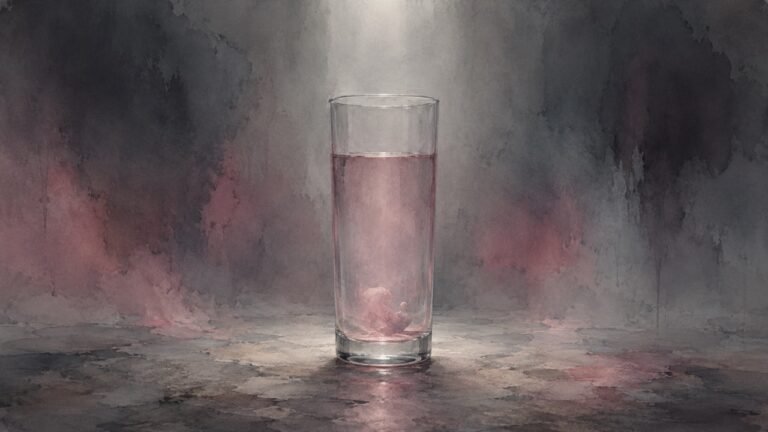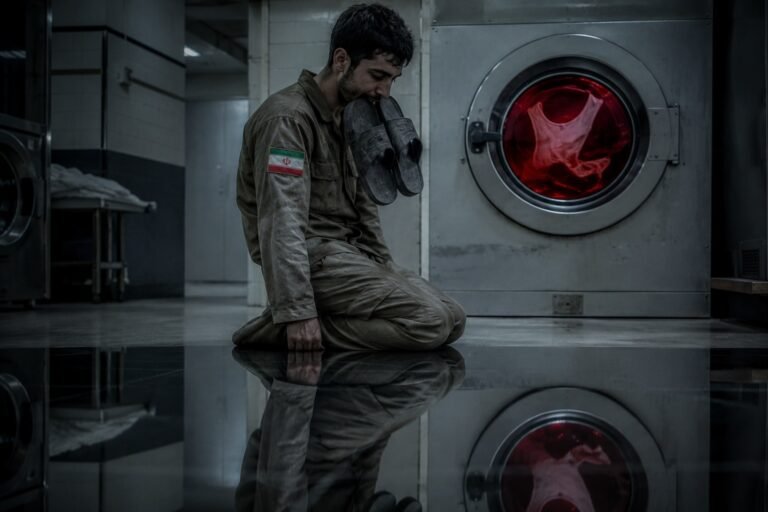

When the corpse-cleansing ladies brought Mum in and laid her on the slab and pulled back the cloth from her face, Auntie fainted. Nazi, the wife of Gholam the flower seller, rushed off to make a glass of sugar water and brought it back. She tipped it into Auntie’s mouth gulp by gulp, half of it going down her throat and the other half down her blouse. Parisa was outside crying and couldn’t bring herself to step inside the mortuary. I wasn’t quite tall enough to see over the glass, so I rose up on my toes to get a better look at Mum.
The corpse-cleansing ladies began pouring water over Mum’s bald head with a hand-held shower. Then they lathered her face thoroughly with a loofah and soap. They cleaned her closed, lash-less eyes, which had come to look like a lizard’s, with the tips of their fingers, carefully, as though worried the soapy water might get in and sting. Her ears too, which without the hair on her head jutted out like lettuce leaves, they scrubbed with a mitt and rinsed well. Mum’s skin had turned a genuine elephant grey, except for the needle marks from the drips, which had blotched the veins along both arms in clusters of purple. The nails on her hands and feet were the yellowish-white of a cockerel’s claws. When the ladies had finished with her head and neck, they drew back the cloth from Mum’s chest. Where her breasts had been there were now two incision scars like a large letter V, because they had cut them off and thrown them away a few months earlier; the cancer had taken over everything.
Cancer is a disease like a tree. At first it is a tiny seed, the size of a chickpea, then little by little it grows, getting bigger and bigger, until in the end it is the size of a person, or even larger. At that point, the disease — the cancer — is all that remains in place of the person. Which meant that this body the corpse-cleansing ladies were carefully turning this way and that, scrubbing with soap and loofah, making neat and presentable, was not my mum. It was the disease under Mum’s skin. The good thing about cancer is that it isn’t contagious, and once we had wrapped it in a shroud and put it in the ground and covered it with earth, the worms and beetles of the grave would have at it and finish it off, and within a few days nothing would be left of it at all.
All these thoughts were in my head that evening when we came home from the graveside, exhausted and worn through. Parisa and I were alone together in the room, and she was chattering away in her sweet musical way, telling me that:
‘Tonight is Auntie Niloofar’s first night in the grave. Two angels, Nakir and Munkar — one has written down all her good deeds and one all her bad ones — are questioning her right now. They have scales, and they weigh everything a person has done in their life. If the pan of bad deeds tips heavier, the person goes to hell; if the pan of good deeds tips heavier, the person goes to heaven. All of us, Saman, have two angels — one on the right shoulder, one on the left — but they’re invisible, we can’t see them. Oh, and there’s one more thing, some bad news: tonight, being the first night of the grave, the grave will press down on Auntie Niloofar.’
Parisa had frightened herself with her own words. She jumped up suddenly and came and sat beside me and gripped my right hand in both of hers and pressed herself close.
When I asked where she’d heard all that, she said she had stood behind the kitchen door that afternoon and listened to her mum talking with my aunt while they packaged up the charity meat to send round to the neighbours, so that the grave wouldn’t press down on Mum too hard. I didn’t want Parisa to move from my side, so I said nothing — I didn’t tell her that when we little ones eavesdrop, grown-ups tell each other lies on purpose so we can’t understand what they’re actually saying.
The thing about Parisa is that she is very beautiful. You never tire of looking at her, and when she speaks her voice is so sweet that it really doesn’t matter whether she’s telling the truth or not. You just want to go on listening to Parisa and never have her stop. Especially those black curly locks that always smell of flowers and shine with cleanliness. It’s a shame she’s so young and talks such nonsense a good deal of the time, but none of that matters. The fact that she was frightened of the pressing of the grave and was sitting like that beside me was more than enough. Still, she gradually grew embarrassed at herself for being a coward and said she was suffocating in the stuffy air of the room and we should go out onto the balcony for some air and to watch the fireflies. Perhaps she also wanted to draw me out, because out on the balcony she said to me:
‘I wish our house had fireflies too. Not one or two. A thousand. Ten thousand. Like this. Like your house. You’d think the stars had come loose from the sky and come down to the ground, flickering.’
Idiot that I am, I was lost in Parisa’s dark eyes and the coiled lock of hair that had fallen loose across her forehead, as though every good smell in the world had hidden itself inside it, and the words were out of my mouth before I could stop them:
‘You don’t have flying ants at your house.’
I realised at once I’d made a gaffe and shut my mouth.
‘What are you talking about, Saman? Are you all right? I’m talking about fireflies. What on earth have flying ants got to do with anything?’
I played innocent to cover my tracks.
‘Oh! Right! Fireflies! Yes, yes, they’re lovely!’
Then she placed her soft, damp palm on my forehead. It was a hand I could never tire of kissing, and it was plain from this alone that Parisa was right and I was not at all well. We ought to go to sleep and be up early at the crack of dawn because there was a great deal to be done — and God help me if Parisa was lying.
The mourning, the third day, the seventh day: they came and went like lightning. Parisa too faded slowly from our house until she was again, as before, my cousin from far away, all the way over in Gisha, up past Shahrak-e Gharb.
Auntie sends a large pot of rice over two or three times a week with Kambiz Khan. At weekends, my aunt makes the trip herself. Dad simply doesn’t know how to cook. The rice he either burns or turns to mush, though his omelette and a dish called mirza ghasemi come out well enough. We eat those with the rice. Sometimes it’s kubideh or chicken that he orders in. The awkward thing is that I’m home at twelve but Dad doesn’t get back until five. So he prepares tomorrow’s lunch the night before, and when I arrive I just need to warm it on the hob.
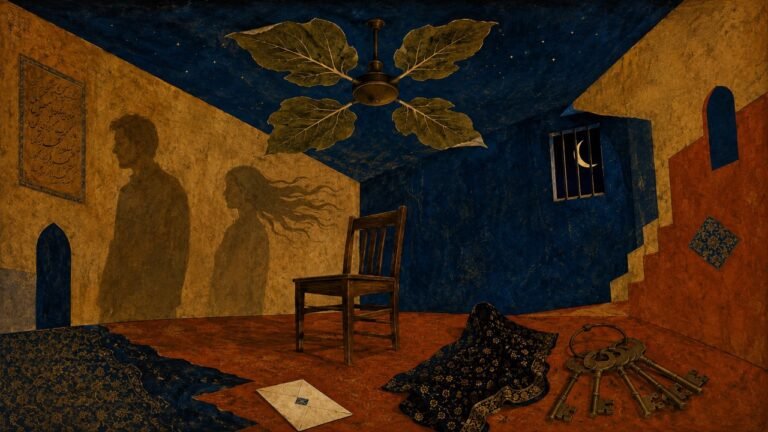
Every time I open the courtyard gate, I find my eyes drawn helplessly to the large empty light socket on the balcony, the one like a great eye looking down at me standing in the gateway — it doesn’t even look away when I’m right there on the doormat. The sight of that empty socket brings a lump to my throat; my eyes fill with tears, but my lips are smiling and my heart is beating fast — faster even than when Parisa jumped with fright and clutched my hand to her chest with both of hers. Because that socket and I are both watching the green door, waiting for someone. Someone whose secret belongs only to the three of us: me and Mum and the empty socket. I just have to be patient, to count the days until Mum’s fortieth has passed and the dust has settled and Mum is quite forgotten. When Auntie and my aunt stop sending pots of rice and everything goes back to normal, exactly as it was before Mum died. A few months ago Mum told me this secret and made me swear not to breathe a word of it to a soul — not even to Dad. Because if I told anyone, the spell of the secret would be broken and things would not happen the way she said they would. And because I so desperately want things to happen the way she said, I haven’t told a soul, not even Dad.
It had only been a month since they had taken Mum’s right breast, but it didn’t matter because the cancer had spread from the breast to her liver and she needed chemotherapy. She was standing at the hall mirror, trying to hide the first bald patch — round as a coin, just above her right ear — by combing her hair this way and that, when I was out on the balcony sweeping the dead flying ants into the dustpan, and all at once I burst into tears. She dropped the mirror and came running. At first she thought something had happened to me and started checking me over.
‘What’s the matter all of a sudden, Saman jan, talk to me. Does something hurt?’
‘Yes!’
‘Where? Where does it hurt?’
‘My chest bone, here, under my throat.’
She was staring right into my eyes when a smile spread across her lips. It was obvious she knew I’d spent the afternoon hiding behind the bedroom door listening to her and Dad arguing, because without any preamble she said:
‘Are you frightened I’m going to die?’
The moment she said it I felt my face flush hot and crumple. I began to bawl out loud with the force of my crying. She pressed my head firmly against the hollow where that missing breast had been, and even as she was shedding tears herself she let out a great peal of laughter. For a few minutes she rubbed my back with the flat of her hand until my crying turned to hiccups.
‘You daft thing!’
‘Why?’
‘Did you really think I was going to die?’
‘Aren’t you?’
‘Mums never die!’
I pulled myself back from her embrace and looked at her again.
‘They don’t?’
‘Not until their children have grown up and found their feet. After that, yes.’
‘So you won’t die until I’m a man?’
‘Of course not. God never leaves children without a mother.’
‘So you’ll get better?’
‘I have cancer, Saman jan. Cancer is a disease like a tree. At first it’s a tiny seed, the size of a chickpea, then little by little it gets bigger and bigger, until in the end it’s the size of a person, even bigger. At that point there’s nothing left but the cancer.’
‘So where does the person go?’
‘Exactly. Where do they go? When mums get cancer they’re buried, but after forty days they come back to their children, more beautiful and lovely than before.’
‘You’re lying.’
‘No mother or father ever lies to their child — unless…’
‘Unless what?’
‘Unless the children are caught eavesdropping. When that happens, parents lie so that the children will stop listening in.’
‘So everything you and Dad were saying to each other was a lie!’
‘Let that be a lesson to you — don’t go listening to grown-ups from behind doors!’
‘So is it really true that mums never die?’
‘Try it for yourself — it won’t cost you anything. Starting tomorrow, bury all these dead flying ants in the garden instead of throwing them in the bin. You’ll see for yourself: after forty days, the ones who had small children will come back right here to their babies, more beautiful than before.’
For exactly forty days, every night, instead of tipping the dead flying ants into the rubbish bin I buried them in the garden and kept a careful count at the back of my sketchbook. On the fortieth night, the light bulb suddenly burst with a loud crack and shattered in tiny pieces over Dad’s head. Mum and I ran upstairs to the balcony, but mercifully nothing had happened to Dad. From the next night, the fireflies gradually began to appear. Like stars torn loose from the sky that had come down to earth and were flickering. Within a week the whole balcony was full of mother flying ants who had returned, more beautiful than before, in the form of fireflies, for their children.
‘You see, Saman? Didn’t I tell you mums never die? Didn’t I tell you mums never lie? You saw it with your own eyes. Do you believe me now? Aren’t they lovely? Now tell me something: would you like to see what I’ll look like when I come back?’
I was standing there with my mouth hanging open.
‘You… you actually know what you’ll look like?’
‘What did you expect? Mums know everything! I even know what I’ll look like when I go.’
‘Won’t you go looking the way you do now?’
‘The last time you see me, my head will be completely bald, like a peeled egg. My eyes will be like a lizard’s eyes, with no lashes. My ears will be sticking out from the side of my head like lettuce leaves. My skin will have gone elephant-grey and my nails will be yellowish-white like a cockerel’s claws. That’s when you’ll know that what you’re looking at isn’t me any more. So who is it?’
‘The cancer.’
She pressed me to her chest again, the chest now empty of both breasts, and this time we were both laughing our heads off.
‘Now let me show you what a lovely face I’ll have when I come back! But first you have to make me a promise.’
‘What promise?’
‘Promise me that when I come back like that you’ll love me even more than you do now.’
‘I promise.’
‘On your honour?’
‘On my honour.’
She went and got her phone. She searched for a moment and showed me a photograph of a woman.
‘Isn’t she lovely?’
‘She’s so beautiful. Like an angel. She’s so lovely. Is that how you’ll come back, Mum?’
‘Exactly like that.’
…
And she came back. Exactly like that. Like the flying ants I had laid to rest in the earth with scorched wings, but who came back to follow their children, their wings full of light. Because mums never die. Because mums never lie.
On the first Wednesday after the fortieth night, the woman in the photograph came to life, and Mum appeared in the green door-frame behind Dad, with a shyness about her as if she were apologising for being a few days late. I ran to her without thinking and held her with everything I had, right there in the doorway, and smothered her hands and her face in kisses. She, glancing wide-eyed at Dad’s wide eyes, pulled me into a chest that was, if anything, fuller than the first one had ever been. She hadn’t come to stay, and she had no wings full of light to fly away on, but I cried and wouldn’t let her go, and so she stayed with us for good. She is kinder even than my first mum, and I love her much more, just as I promised — though I still haven’t managed to break the bad habit of listening in on grown-ups.
Last night they were sitting out on the balcony, eating watermelon and chatting.
‘Where on earth have all these fireflies come from, Morteza? We should get a pest man in. They could make us ill, you know.’
‘Good grief, women. It was Niloofar — she paid her cousin’s son a fortune to collect them from the forests of Gorgan and bring them here without Saman seeing. And now here you are saying let’s call the pest man in and massacre the poor creatures.’
‘From the forests of Gorgan? Without Saman seeing? What do you mean?’
‘She told me not to ask why, so I didn’t. Don’t you ask either, because I don’t know. She also said to smash the light bulb.’
‘Behind Saman’s back, presumably?’
‘Well — yes! How did you know?’
‘”Because mums know everything.”‘
When Mum said that I nearly burst out laughing. I slipped off my sandals, picked them up, and tiptoed back to my room, because it was plain as day they’d realised I was listening and were now lying to each other as easily as breathing.