
It is seven in the evening on a Sunday, the tenth or eleventh of July, and I am still thirsty. There is a smell of wet sulphur and iron filings. The smell of a damp mop, as though it has been dragged across the filth of the corridor no more than five minutes ago. As though someone has been hauling the carcass of a dead animal across the floor.
A voice comes from somewhere distant. Someone shouts:
“Who’s tired?”
The soldiers answer instead of the enemy: en-e-me.
“Who’s tired?”
“En-e-me.”
“Who’s tired?”
“En-e-me.”
In the noise and the unison of their voices, no one notices the difference between enemy and en-e-me.
* * *
Satari never understands how to mop a floor properly. He walks straight back over the section he has just cleaned, and he never wrings the mop out properly either. The dirt catches in it and he drags it along the floor again.
I should have been able to go out there and break that mop over his head. I should have been able to take that grey mop in my hands, rinse it carefully, and bring the corridor floor up to a shine. I cannot. The door is locked and I am trapped in solitary.
The sound of the en-e-mes has grown more distant. Five hours, no, six hours, it must be two hours that I have been stuck in here. It must be seven o’clock. Because we were supposed to have finished mopping the main corridor by half past six. After washing the clothes, this is my second favourite job in the barracks.
I should have been able to do it. I should have taken the Tide washing powder and dropped that sweat-yellowed vest into the tub of water. The smell of Tide steadies me. I wanted to pour it onto a flat surface and inhale it through my nose. The smell of those little blue granules makes me feel well again.
Commander Shibani’s vest was always the dirtiest, the most yellowed of all. But his sweat had no smell. He would pull it off in front of me. He would drop his uniform jacket over the chair and sit down on it. He was thin but his voice belonged to a heavy man. Or perhaps he spoke that way so that we would fear him more.
I should have been able to tell him: speak in your own voice. I am frightened enough of your eyebrows. His eyebrows reached to the floor. Long and black. Everything he felt showed in those eyebrows first. If he laughed or coughed, the first thing that moved was those eyebrows.
He would sit in his chair and say: “Naseri, the washing machine ruins my vest. Take it out. Wash it so it shines like the first day. I want it white again.” And I, following the line of his eyebrows, would move forward with my hands and stand beside his chair.
In the barracks he was the only one who cared so much about cleanliness, about washing. The warmth of his breath, of his presence, reached me. The hair on my body stood up. I could have dissolved right there.
But the hands. I could still move my hands forward and pull his vest free from his trousers. He fastened his belt so tightly that I would have to struggle with it several times. He fastened it tight to make that small, round belly of his appear flat. To sit straight and keep his authority intact.
Where is he now, and who is taking his vest off for him? I had brought it up to a shine myself. I had washed all the yellow out of it, poured it into that red tub and watched it go down the drain, and the drain had made a sound like a belch and swallowed the filth.
I should have been able to get up now and drink from that drain water. Every part of me has gone dry. Satari must still be in the corridor. Perhaps he could bring water.
I drag myself along the floor. With my mouth, with my feet, with everything except my hands, I reach the door. It is metal, and when I lean against it, it seems to give slightly, to sink inward. It makes the sound of a ladle striking the bottom of a pot. The smear of filth and grime from the waists of the men before me has been left on it. The unavoidable contact with the door disgusts me but I have no choice. I throw myself against it so Satari will hear me.
The last time, I had reported him to Commander Shibani for taking two portions of food. He had been made to mop the entire barracks for a fortnight. He would certainly not bring water even if he heard me. But I keep kicking the door with my foot and calling his name.
The soles of my feet have gone black and the fibres from the detention room carpet have stuck to them. My feet have never been this black before. I am thirsty. I want water.
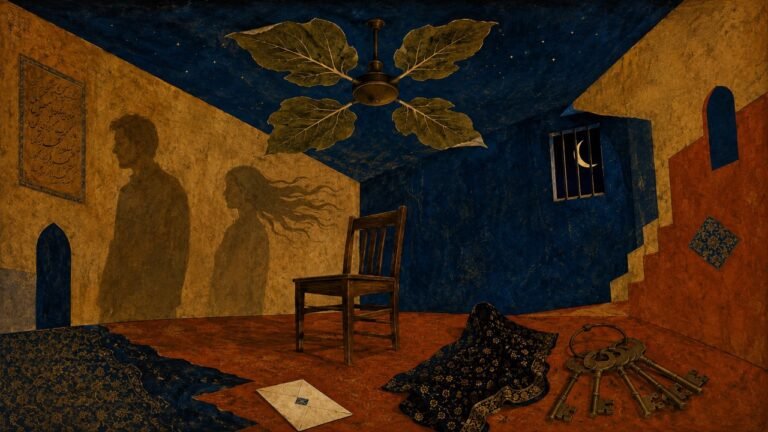
Someone comes to the other side of the door. The light coming through the small window above the door dims for a moment as a shadow passes in front of it. He must be tall to block the light like that. It must be Colonel Omidvar. He has brought water. He knew I was thirsty and has brought water.
He turns the key and I throw myself to the side of the door. The door is faster than me and as it opens, its sharp edge takes a chunk out of my bare ankle. I must not cry out. It does not hurt that much. But blood comes and this frightens me. I should press my hand against it and stop the bleeding. I cannot.
More importantly, I must stand up, straighten myself, and bring my feet together as a mark of respect. I press myself against the wall behind me and try to use it to push myself upright. I remember that the walls are dirtier than the door and now, without hands, without hands, the only way I can stand is to press my back against this filthy wall. My skin crawls but I pull myself up and stand, and bring my bleeding right ankle against my left foot.
A drop of blood spatters onto Colonel Omidvar’s trousers. Only I see it.
He steps forward and looks me up and down. He does not expect me to stand straight. He expects my knees to buckle, for me to wet myself in fear in front of him, and then for him to shout in my face. He has another thing coming. However much blood comes from my foot, I will stand straight.
Nejati is standing behind him. He shakes his head, meaning: you are finished. The sweat under his arms has soaked through and two dark circles have formed between his arms and his sides. I can smell the sourness of him from here. I want to shout at him. But the Colonel takes one more step forward and my knees begin to tremble. They buckle and I try to step back. Now his authority has begun in earnest. He shouts:
“Stand up straight, Naseri. Have you come to your senses or shall I have another two days added?”
“Two days? I have only been here two hours.”
He is trying to deceive me. I know this from the scraps of meat from the stew he ate at lunch, still lodged between his teeth. He steps closer and opens his mouth. The smell of onion. A large white onion he has swallowed whole.
“Are you going to talk or not? Where is Commander Shibani?”
I want to put my hand over my nose. I cannot. Instead I open my mouth.
“Sir, could you please bring me a glass of water?”
He glances at my cracked lips. He can see the parched depths of my throat. Nejati, though, has stuck his tongue out and is signalling that water will come over his dead body. He has not forgotten what I did to him: I had told the Commander that he had smuggled a phone in and was sneaking off to the back of the barracks to make secret calls. He had been made to polish every boot in the barracks for three weeks. In that moment when he stuck his tongue out I felt it had gone black from tip to root and tasted of boot polish.
The Colonel, without turning back, raised his hand and shouted: “Nejati, bring him a glass of water!” Nejati pulled his black tongue back in, tried to shout a response, then clicked his heels together in fury and walked towards the far end of the corridor. The Colonel, though, did not wait for Nejati to return. He repeated his dreadful question.
“Where is Commander Shibani, Naseri?”
“How should I know, sir?”
“How should you know? You were always with him.”
“Sir, that is not reason enough. I was not with him after two o’clock.”
He narrowed the corners of his eyes. His entire round face creased. The smell of stew had soaked into every part of him and was now pouring out of his mouth. I felt that every word he spoke launched a crushed chickpea from his mouth onto my face.
“Don’t try to wind me up. He hasn’t signed his exit papers.”
He swallows a belch, and one chickpea misses its target. He presses on:
“So he hasn’t left the barracks. Which means you…”
That swallowed belch rises again almost to the tip of his tongue. He closes his mouth and cuts off his sentence to force it back down. He wants to be serious, to deliver these serious words firmly and precisely. He cannot. He has eaten too much stew and it is coming back up. He collects himself again.
“Which means you were the last person to see him.”
I could see Nejati approaching from the far end of the corridor. He was bringing water and I was going to have to forget how much I despised him and his greasy, filthy body. On the way he spilled half the water on the floor. I wanted to shout at him but I saw that the one who was shouting was Colonel Omidvar, whose mouth was open and whose smell of onion and that suppressed belch was reaching every pore of my skin. I should have put my hand over his mouth. I could not. My hands did not work. My hands were gone.
I had washed his vest two or three times at most. Now I could see a small triangle of it poking out from his collar. He always changed his vest after a few wears and bought a new one. Exactly unlike Commander Shibani.
* * *
Commander Shibani did not look up. He kept writing, without raising his hands. Not as though he were writing anything important. He was writing the barracks shopping list. I wanted to tell him quietly to add five boxes of Tide washing powder for the laundry. The ones with the blue granules. I did not say it.
His hands, unlike his eyebrows, looked delicate and fragile. I knew how carefully and thoroughly he washed them, and that he kept a hand cream hidden in the bottom drawer of his desk. Only I knew this. An unspoken secret between me and Commander Shibani. We both used that cream in secret and each time I could not take more than a finger’s width of it. He kept count. But I think he knew I was using it too. He had caught the smell on me a few times. It smelled of orange. Orange that trailed off into apple and coconut at the back.
I would have needed him to raise his hands for me to pull his vest free. I waited in silence for him to finish writing. As though he had heard the voice inside my head, he said: “While I finish this, take my socks off.” Then he pulled his feet out from under the desk and stretched them towards me.
At times like these the soldiers would say the Commander had lost the plot. And Commander Shibani was the most plot-lost commander in the barracks, and I was apparently his favourite. He took pleasure in the fact that whatever he asked, however strange or difficult, I would do it without flinching. I would lay everything bare for him, and most importantly of all, I would bring his clothes and that precious vest of his up to a shine.
When I had removed both boots completely, I noticed the smell of his feet for the first time. I had not expected it, but his feet had no smell at all. That part of the body where you expect all the smells of a person to have gathered had no smell whatsoever. Just a collected, odourless air.
His socks were grey and smelled of fibres and thread. Where the elastic had gripped, it had left a mark around his calf. Like a railway track. A railway track with dark weeds growing around it. His legs did not have much hair. The weeds were thin and faint. The darkness was so washed out it could have been fair. It could have been brown.
I remembered that the train left at two o’clock, and that if I washed these socks properly, the Commander would release me earlier than anyone else and I would make the two o’clock train. I was handing my ticket to the conductor when the Commander called my name quietly. He never raised his voice at me. Whatever the task, however difficult or strange, he would tell me quietly, and this made all the difference to me.
He said quietly: “Scratch it. Scratch where that wretched elastic has been. It’s been driving me mad since this morning.”
At that very moment the door opened and Nejati came in. He brought his feet together and stepped forward and placed a folder on the Commander’s desk. I was still kneeling, scratching the mark. He glanced at me. A smirk spread from his head to his feet. Every part of his body was saying: scratch away, scratch away, you’ll never get any higher than this.
Still smirking, he turned to leave, clicking his heels, when the Commander shouted:
“Wait, Nejati.”
His feet froze mid-air. The Commander continued:
“Were you not on guard duty last night?”
The smirk had now completely vanished. He did not know how to move his lips. I lowered my head and scratched the other track. His mouth filled with foam that dried at the corners the same instant.
“Why… yes, sir.”
“Did you pay the duty sergeant a few tomans to cross your name off and disappear?”
A fleck of spit flew from his mouth and landed on the shopping list paper. The very paper where I had wanted the Commander to write, with those pale hands of his, Tide. I was the only one who saw that spit spreading across the paper.
“Sir…”
Another fleck launched from his mouth towards my face and fell short. He pressed on:
“Not another word. Stand to attention right here in front of the Supreme Leader’s portrait. You do not move until I say stand easy. Not a muscle.”
“Until you say stand easy, sir? But sir, the portrait…”
“Silence. Stand to attention.”
It was an inventive punishment. He had not improvised it on the spot. I suspect he had been turning it over in his mind since the day before, waiting for the right moment. I wanted to burst out laughing. To shout. To pull up a chair and sit facing Nejati and stretch my legs out on the desk and watch him standing to attention for the portrait until nightfall, and dab at the drool hanging from the corner of his mouth with a clean cloth.
I knew that great lump of his would fold within five minutes. But now he had fixed his eyes on the lips in the portrait with such intensity that he seemed to genuinely be waiting for them to move and say: stand easy.
* * *
At last Colonel Omidvar closed his mouth and waited for Nejati to bring me the water. While he waited he clenched his fists. Nejati crossed the threshold and came inside. I knew he had something planned. That permanent smirk of his was creeping back onto his face.
I watched only the half-empty glass in his hand. The palms of his hands were sweating and the prints of his fingers had been left on the rim of the glass. The saliva in his mouth had pooled again and if I did not take the glass from him in the next few moments his spit would overflow and pour into the water. He deepened the smirk and placed the glass of water on the floor.
The bastard knew better than anyone that I could not pick it up.
The Colonel unclenched his fists and shouted: “What are you staring at, Naseri? Didn’t you want water?”
“I can’t, sir.”
“You can’t? Don’t give me that. Pick it up.”
“Sir, I can’t. I can’t move my hands.”
“Since when are they your hands?”
“They’re not mine, sir.”
His patience had run out and he no longer knew what he was saying. He opened his fist and struck me across the head with his palm and knocked me to the ground. I fell face-first onto that filthy carpet. It smelled of dried fenugreek. Of old damp that had been left to sit. I wanted to peel my face off right there. To detach it from my body so that the smell of the detention room floor would be separate from me. There was no way. With which hand would I peel my face off.
“To hell with it. You don’t need water. Explain to me right now where your commander is.”
Nejati, as though his heart had softened, or perhaps to ingratiate himself, said: “Sir, permission to give him water? He’s right that he can’t move his hands, poor sod.”
I slowly raised my head and tried to pull myself up with my shoulders. He got his dig in at the end. Poor sod is his entire being. The Colonel seemed to have only just believed it.
“He can’t?” he said. “If he’s got a disability then what the hell is he doing here?”
Nejati, keeping up the appearance of a reasonable man, said: “No, sir. It’s recent. I think it’s been about three days.”
* * *
It was half past one in the afternoon and everyone had gone to collect their food. I was sitting on the floor of the laundry room and had told Naeimpour to bring my meal to me. I had scrubbed the floor and was enjoying the thought of taking my boots off and walking across that polished surface. Feeling the cool cleanliness of it under my bare feet. Lying down and listening to the sound of the clothes turning in the machine.
Naeimpour knocked softly and with great fear, and slipped the food through the gap in the door in a way that kept him hidden from the corridor camera. His anxiety and excitement were greater than the act of handing me that frozen Persian goulash. He kept looking this way and that, and the moment I took it from him he ran towards the yard.
From the window I could see him heading for the garden. The section of garden that sat in the middle of the barracks was visible from the second window of the laundry room. I knew that after him, Reza Heydari would certainly enter the garden. Reza Heydari had grown bold as brass. I watched him pull his trousers down. They had gone between watchtowers sixteen and seventeen. There were two trees there which had earned it the name garden. The cameras had no view of that corner.
The third machine started drying the clothes. Its red light had come on and it was throwing the clothes rapidly up and down. At the same time, through the window, I could see Naeimpour moving his head up and down, his eyes still darting fearfully in every direction.
When machines one and three started drying, I took my boots off and pulled the red tub down from the shelf beside the third machine. The Tide washing powder for the Commander’s clothes was already inside the tub. This time his seasonal clothes had been given to me as well, to be washed separately by hand, and he had emphasised that the collars should be treated gently. But first I went for his vest. It needed time to go properly white. It had to soak in the water and suds for a few minutes.
I dropped the vest into the tub and poured the Tide over it. I remember clearly that because I was in a hurry to catch the train I did not smell the Tide this time.
I was transfixed. I sat there beside the tub. I saw myself, hands on my head, reflected in the polished surface of the laundry room tiles. I do not know. All the water turned red. I could not make out any white or yellow in the tub. I smelled the Tide and it burned me all the way to where my nose connects to my brain. I was afraid to put my hand into the tub and pull the vest out. I thought it might be acid or something. My mind could not make sense of it. I knew it was Nejati’s doing. He had finally got his revenge.
I wished I had put the seasonal clothes in first. You could buy a thousand replacements for those. But that wretched vest, bought for him by his dead wife, there was only one of it in the world. He could identify its smell from a hundred paces. He knew his own smell in it. He knew exactly where it was stained and how many shades lighter or darker it had become each time. He knew every thread of it by heart.
He looked at the vest. He said: “Naseri, look what you’ve done to my clothes.” And then he fell silent. He had not even managed to be as angry as he wanted to be. He had never been angry with me before. I had done everything in my power to ensure his eyebrows never lengthened on my account.
His hands were freshly creamed. The smell of orange had just reached apple and coconut and had spread through the entire room. He clenched his hands. They were too smooth to grip each other properly. He could not show his fists properly. He did not know what punishment to reach for. Each time he looked more closely at the vest his eyebrows grew longer. As though the continuation of the red of the vest was dripping from his eyebrows. His voice was quiet. He did not want me to hear the trembling in it.
“Why didn’t you take it out the moment it happened?”
His voice was still quiet.
“I was scared… I was scared my hand would burn, sir. I thought it was acid.”
When I said this it was as though cold water had been thrown onto a kettle, because it began to shriek. He came forward and grabbed my collar. His hands stuck to my collar and I felt the print of his creamed fingers settling into it. He was breathing hard and trying to work out how to be angry. How to be angry with me and show it properly. His face, from that distance, seemed soft and smelled of orange.
“You ruin my clothes and all you were worried about was your hands? Those useless hands of yours.”
He fell silent but his mouth was still open. His teeth were clean and his breath had no smell. He moved his lips and continued:
“You should have let them burn.”
Then, as though he were not ready for what came next, he closed his mouth and stared into my eyes. After a moment he let go of my collar and knotted his hands in the air. They were too smooth and could not grip each other. He could not show his fists properly. He thought there had still been hope but I had taken it from him. He ground his teeth together. He no longer knew what to do with his body to show his fury. He said it again: “Those bloody hands of yours. Because of your filthy hands you let my clothes…” He could not even bring the last words out properly.
But in that inarticulate moment he made a decision. He chose his punishment. He turned and looked into my eyes.
“You’ll go and stand outside my room and guard my slippers.”
He paused and continued:
“You will not take your eyes off them. You will not let anyone put them on or touch them. You are not permitted to use those damned hands of yours. Understood?”
He had no grip on his breathing. The punishment was coming to him in the moment and he was voicing it as it arrived. He turned and drove the next sentences into my ears harder and louder.
“You are not even permitted to scratch your own head. You will stand in front of my slippers. If necessary you will polish them. Every time I come out of the bathroom they must be clean, but you are not permitted to use those damned hands of yours. Think of yourself as having no hands.”
How had it come to him. He always tried to be inventive in his punishments. He did not want this anger to look like all the others. This anger was different. It was an anger born of love. Love for his dead wife Sudabeh, and for the only keepsake of her that remained. That garment was the only thing that still reminded him he loved Sudabeh.
I knew he would be thorough enough to check me on every camera. He would account for every inch the slipper moved. I understood that I was finished.
I was standing in the corridor outside his room trying to ensure my hands did not move by so much as a twitch. A voice came from somewhere distant: “Who’s tired?” The soldiers’ answer was further away and I could not hear it. But in my mind their answer kept repeating.
Satari was approaching from the far end of the corridor. He was so thin and elongated that from a distance you could not tell the difference between him and the mop in his hand. He dragged the mop back and forth without energy and left the tiles dirtier than before. He was getting closer to Commander Shibani’s room. To me, the slippers, and the room. I felt the way you feel when an enemy approaches with a high-calibre weapon and you are standing there defenceless.
I needed to move the slippers out of the path of the mop and stand myself in the section he had supposedly cleaned. I relaxed the muscles in my hands and let my fingers hang loose from the wrists. In my mind I kept repeating: think of yourself as having no hands. If you had no hands, how would you move the slippers?
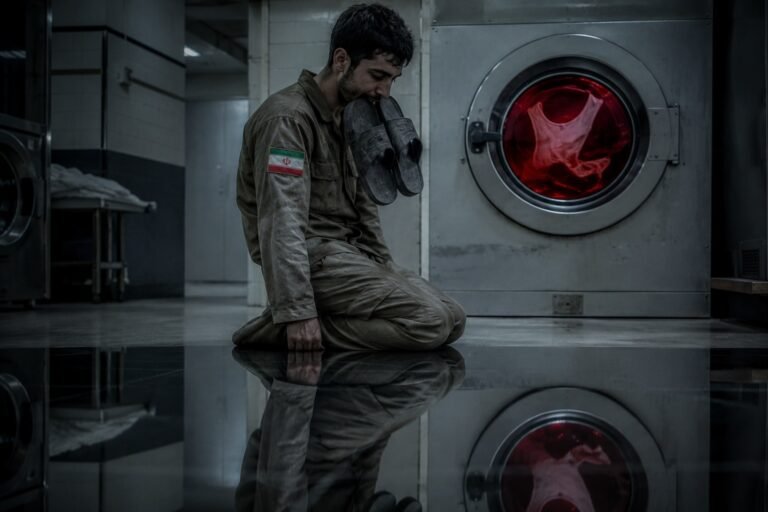
I dropped hard onto my knees and bent towards the slippers with my mouth. I knew he wanted to see me bend down. If I had kicked the slippers aside with my foot he would have had me. There is a humiliation in moving a man’s slippers with your foot that anyone can feel. I must not humiliate him. I took the slippers in my mouth and dropped them in the section of wet tiles. Now I needed to spring upright from that same broken-kneed position. Without deliberately moving my hands.
Satari was watching me. The penny had dropped for him about what my real punishment was and now his revenge was to make sure everyone knew. Before long, anyone whose path did or did not lead that way was passing through that corridor and doing something that required me to move my hands.
Reza Heydari’s rank was higher than mine. I could say nothing to him. He was two months my senior. He was getting closer. He was dragging his feet along the ground and getting closer to me and the slippers. I thought: whatever he does, I will hold the line. I will resist and protect those slippers. Even without hands I will save the life of those slippers.
Now he was standing directly in front of me and staring into my eyes. His expression was blank. I was so caught up watching his eyes that I did not notice he had unzipped his trousers and was urinating on the slippers.
As though ambushed, I let out a soundless cry and threw myself over the slippers. I landed on my shoulder and my hands flew out to either side. In my head it kept repeating: think of yourself as having no hands. The smell of the damp mop and a dead animal carcass hit me in the face. I wanted to tear off my face and nose. To not be in such close contact with this floor, this filthy floor.
His piss was warm and was pouring down my back. As though he had drunk all the water in the barracks and wanted his entire being to be piss and pour it over me. His piss struck my back where I was bent over the slippers and ricocheted onto the surrounding tiles. Satari shouted from the far end of the corridor that he had just mopped there.
The last few drops fell. He drew a satisfied breath, then tilted his head slightly downward and said:
“Zip me up, sweetheart.”
Then he pursed his lips and pushed them forward.
I was stunned. I wanted to raise a white flag right there. I could not. With which hand would I hold the flagpole? I had to resist. How was I supposed to zip him up without hands.
My body was crawling from the dampness and my clothes had stuck to my back. I stood up. Slowly, from the base of my spine, from the place where it connects to the legs, I arched backwards and my hands swung forward and back. I could feel them but I had to make them look numb. He was watching me on the camera in his room.
I knelt directly in front of Reza Heydari. His head was down and he was looking at me. I leaned forward with my mouth and caught the tongue of his zip between my teeth and pulled it up. It smelled of damp fabric. Of cold and damp that had been left to sit. Of sick man’s urine. I pulled the zip up in one breath and raised my head. He held it there for a few moments with the flat of his palm and then ran his hand over my head and walked away.
I stayed on my knees for a few moments. I could still feel the pressure of his hand on my head where it had held me down for those few seconds. I tried to recall the last good smell I had in my memory. No good smell came. My body no longer knew how to show its revulsion. My hands had locked. I felt them beginning to prickle. But I must not give them that right. It was all their fault. Everything I suffered was because of them. The wretched things: if they had not been afraid, my whole body would not now smell of piss. My feet, my nose, my ears, my back stuck to my shirt which was begging me to pull it free: every part of me wanted to deny the existence of those hands.
I needed to change my clothes and wash the slippers. I thought that if I carried those piss-soaked slippers to the bathroom in my mouth, I would be the laughing stock of the entire barracks for months. I had to take them somewhere safe. My sanctuary. It was far but it was worth it. I held them together and gripped them in my teeth by the middle. They almost completely blocked my view and everything looked grey. I thought that this smell, now so close to my nose, would live under my nostrils forever.
When I reached the middle of the yard one of the slippers fell. Landing on my knees on tarmac hurt more. For a moment it seemed as though everyone wherever they were stopped and stared at me. The guards were hanging off the tops of their watchtowers laughing. Their sound echoed through the entire barracks. I wanted to silence every one of them. I could not. With which hand would I silence them?
For a moment I imagined a thousand hands growing out of me, covering the mouths of every person in the barracks. Instead of a centipede I had become a thousand-handed creature standing in the middle of the barracks yard with each hand clamped over someone’s laughter.
When I reached the laundry room I spat the slippers out. There were no cameras there and I could give myself and my hands a rest. I wanted to wash them first. They would not come up. They stayed dry and fixed. I was startled and something collapsed inside me. I could not even feel that they had gone dry and weightless. I called to them in my mind and tried to make them understand that there were no cameras here and they were free. I wanted to brush the dust off my knees. They would not come. They hung there and would not move.
I looked at them. They had gone straight as planks. I tried to bend my knuckles. They would not bend. I could not feel them. I expected them at least to tingle. To drive a needle into themselves. It was no use. They would not move and hung there limp from my upper body.
I felt the rage rise and that same thing collapsed again inside me. Like the moment the Commander’s vest turned red, I was frightened and my breath was coming with difficulty. I pulled myself to the wall beside the window. I had scrubbed the walls of the laundry room myself. They were safe. I rubbed myself against the walls. I felt nothing in my elbows and fingers. Like a roller I pressed myself to the wall and moved up and down. My hands left no mark on the wall.
I was about to cry when someone came in without knocking. His eyebrows entered before he did. Before I could react he opened his mouth. It was Commander Shibani.
“How dare you abandon the post I gave you and come here?”
He was shouting at me. Even when he had given me that punishment he had not raised his voice this much. My mouth went dry. He was speaking in his own voice. I gathered what water I could from every part of me and brought it to my mouth. I pulled myself away from the wall with difficulty and took one step towards him. One slow, trembling step.
The smell of Reza Heydari’s piss twisted through my memory. My clothes were still wet from it and instead of seeing any of this, Shibani was shouting at me. He should not have shouted. That difference had to be kept intact. He said I had ruined his whole day. His worthless day, identical to every day before it. I who had spent the entire time thinking of nothing but protecting his slippers. Not even his shoes. The most worthless thing he owned. His slippers.
“I brought your slippers to wash them.”
“Don’t give me that. If you wanted to wash them you’d have taken them to the bathroom.”
“It was busy in there, sir…”
I had not yet properly absorbed the sound of the previous shout when a louder one came.
“Are you taking the piss out of me, you filth?”
“I have never disrespected you.”
“Shut up. Your whole body stinks of piss. You let that animal do that to you.”
“Sir, you yourself said the slippers…”
“You’ve got no backbone, you pathetic creature. You’ve ruined my entire day.”
His voice was different now. It was the same voice he had used when he told Nejati to stand to attention.
“Sir, you shouldn’t… you shouldn’t shout at me.”
“What? What did you just say?”
He took one step forward to come closer to me. The polished tiles came to my rescue. His foot slipped and he went down hard on his back. He fell flat out, full length on the floor, and cried out. It all happened in under a second. The sound of his cry from falling was different from the shout of a few moments before.
“My back…”
He was gasping and his head was fixed facing upwards, staring at the ceiling. He raised his hand towards me. His fingers were thin, and if I could have seen them in isolation, anywhere in the space of the laundry room, I would have forgotten where I was. They were dry and the effect of the cream seemed to have left them. No smell of orange came from them. As though he could not move his neck, he kept his face to the ceiling and opened his mouth.
“Take my hand. I can’t get up. Who in God’s name made this place so slippery?”
His breaths reached me more than his words. I thought he would be pleased that I had polished the floor so well. I thought the first time he set foot in the laundry room he would be stunned and would say: “Well done, Nima…” Not Naseri. But he had said Naseri. He had said I had no backbone. He had shouted at me. He should not have shouted. That difference had to remain.
He said I had ruined his whole day. His worthless, identical-to-yesterday day. I who throughout had thought of nothing but protecting his slippers. Not even his shoes. The most worthless thing he owned. His slippers.
“I’m talking to you. Take my hand.”
“I can’t…”
“Have you lost your mind, Naseri? You’re free now. Take my hand.”
I could not feel my hands. Even less than a few minutes before. It was as though in the space between my sides and shoulders there was nothing at all. An empty space filled with the smell of Tide washing powder and the cool air of the laundry room. I wanted to shake that compressed air beside my sides and blow it towards Shibani’s hands. I could not.
“I can’t move them…”
“Don’t give me that. Come here, help me up. I’m in agony.”
“You yourself… you yourself said I had no hands.”
“I was talking rubbish. Come on, help me up, I’m dying from the pain.”
He was like an upturned beetle waving its legs, and his eyebrows were its antennae. He begged me to help him up. He shouted every obscenity he knew. This was the first time those obscenities had been directed at me. His tears were almost there. I did not want to see his tears. There was nothing I could do.
When I looked at them they lay still and motionless the length of my body. Shibani was shouting and wanted me to take his hand but there was nothing I could do. I thought of my feet. I could feel them perfectly well. Since I had knelt and pulled up Reza Heydari’s zip I had felt them perfectly well.
It was because of him that I had let the smell of Reza Heydari’s piss linger under my nose like this. Because of him that I reported everyone. Because of him that my hands had gone. And now he was shouting at me with all his strength and swearing at me. He should not have shouted. I had never been shouted at by him before. My legs went weak.
For a moment I did not breathe. I raised my left foot and brought the sole of my boot down on his face. The first one lightly and the second one hard. The first for the slippers and the second for the word backbone. By the third I had found my rhythm. My hands had given all their strength to my feet to crush his face.
One. Two. Three.
I brought my boots down on his head, his chest, his gut. When I kicked his stomach, blood geysered from his mouth. For a moment a bubble of blood formed at his lips. In the reflection of that bubble I saw myself, my feet grown larger than everything else on my body, coming straight down on his face. I burst the bubble and his face was drenched in blood.
He made no more sound. He no longer swore at me. Now his vest had gone red again. His new vest, with no memories in it. How would I clean it. Shibani would not like his vest to be red. I thought I had to make one last effort to clean it.
I dropped to my knees beside his motionless body. Even his eyebrows were still now and silent. I brought my head down to his hands and pushed them upward. As though I wanted to squeeze myself headfirst underneath him, I turned him onto his side. One more push and he would fall face down.
The smell of his cologne had mixed with the smell of warm blood and was turning something strange in my head. A few drops of blood had spattered onto his name and rank, which was crooked on his chest. I wanted to straighten it with my eyes. With my eyelids. I could not.
I sat on the floor and pushed myself under his body and pushed him forward. Like a snake I coiled around the motionless body of Shibani, Sergeant Major Jalil Shibani, my eyes fixed constantly on the name on his chest. I had emptied machine three myself. The hardest part was getting him to the door of machine three. With great difficulty I brought my head under his waist and propped him up and leaned him against machine three. There was no other way. I had to clean him. Whatever it took I pushed him inside the machine and closed the door firmly.
With my mouth I picked up the Tide washing powder and tilted it so that it poured into the slot. The corner of the cardboard went wet from my saliva. A few granules of Tide came onto my tongue. A few blue ones. The smell reached the far end of my nose and my eyes burned and filled with tears. I had to wait two minutes for the machine’s door to lock and then I could start it.
I was thirsty. I have been thirsty since then. From that moment until now I have been thirsty.
Nejati stepped forward and held the water to my mouth. The prints of his greasy fingers were on the rim of the glass. The green light came on and through the glass I could see Shibani’s body curled and tangled as the water poured over him.
I have been thirsty since then. Since then until now, when Nejati has taken pity on me and is holding the water towards me, I have been thirsty.
Colonel Omidvar, though, has lost hope. For the last time he asks: “Naseri. Where is Sergeant Major Shibani?”
I swallow the water and wait for it to reach the deepest part of me and feel its coolness. A voice from somewhere distant shouts: “Who’s tired?” The washing machine sprays suds over Shibani’s tangled body. The voice repeats: “Who’s tired?” The washing machine begins to turn. It makes an indistinct sound. Like the sound of space, somewhere beyond the earth’s atmosphere, steady and one-note. As though its frequency has risen so high that the human ear can no longer hear it. As though a thousand soldiers are all saying en-e-me at once and the difference between that and enemy can no longer be made out.
I should listen carefully.