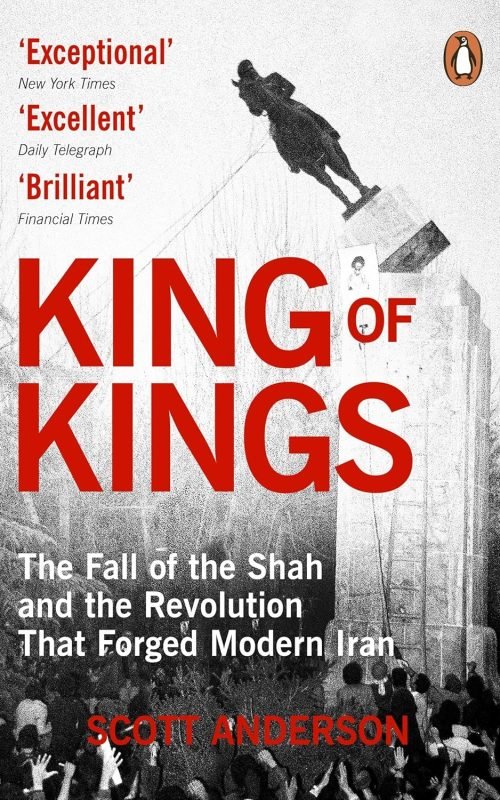
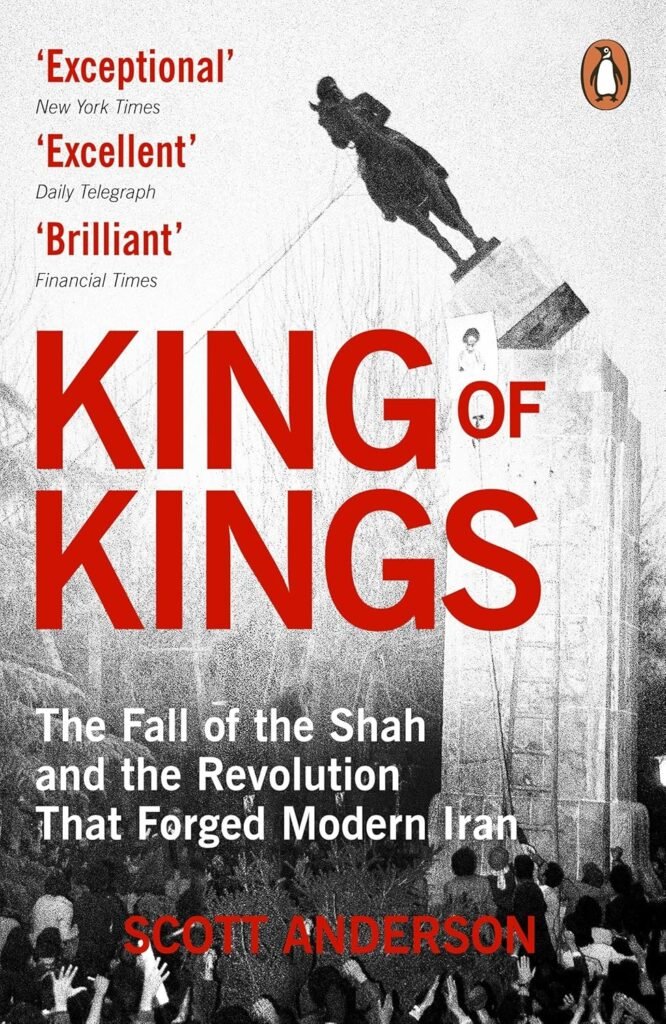
Scott Anderson’s *King of Kings* arrives with considerable fanfare, carrying endorsements from the Financial Times, The Times, the Telegraph, and the New York Times, as well as a place on several best-of-year lists. The pedigree is hard to ignore, and the subject matter is equally difficult to set aside. Anderson, whose previous work *Lawrence in Arabia* earned him a Sunday Times bestseller, turns here to the 1979 Iranian Revolution and the decades of consequence that followed from it.
The book’s central argument, at least as framed by its promotional material, is that the Iranian Revolution represents a foundational event for understanding ongoing conflicts across the Middle East, from Gaza to Syria. This is not a particularly novel thesis, but the promise of *King of Kings* lies less in its argument than in its execution. Anderson is described as a narrative historian, and the book is positioned as a “spellbinding” account rather than a dry academic treatment.
The subject itself is rich with dramatic tension. The Shah of Iran, Mohammad Reza Pahlavi, presided over a well-funded and militarily powerful state, yet his regime collapsed with surprising speed. Anderson apparently examines how a government backed by oil wealth, a formidable army, and a feared secret police could still prove brittle enough to fall to a revolutionary movement. The themes of greed, paranoia, and overreach are cited explicitly by the Financial Times, suggesting Anderson is interested not just in events but in the psychological and political failures that shaped them.
The New York Times calls the book “exceptional,” which places it among the stronger works of recent narrative nonfiction. The Atlantic and the Wall Street Journal also selected it as a book of the year, indicating a broad critical consensus around its quality.
One limitation of this review is the absence of direct reader responses. Without customer feedback, it is not possible to assess how the book reads in practice, whether Anderson’s narrative pace holds across its full length, or how accessible it proves to readers without prior knowledge of Iranian history. What the available evidence does suggest is that *King of Kings* has been received as a serious and well-crafted work on a subject that remains urgently relevant.