
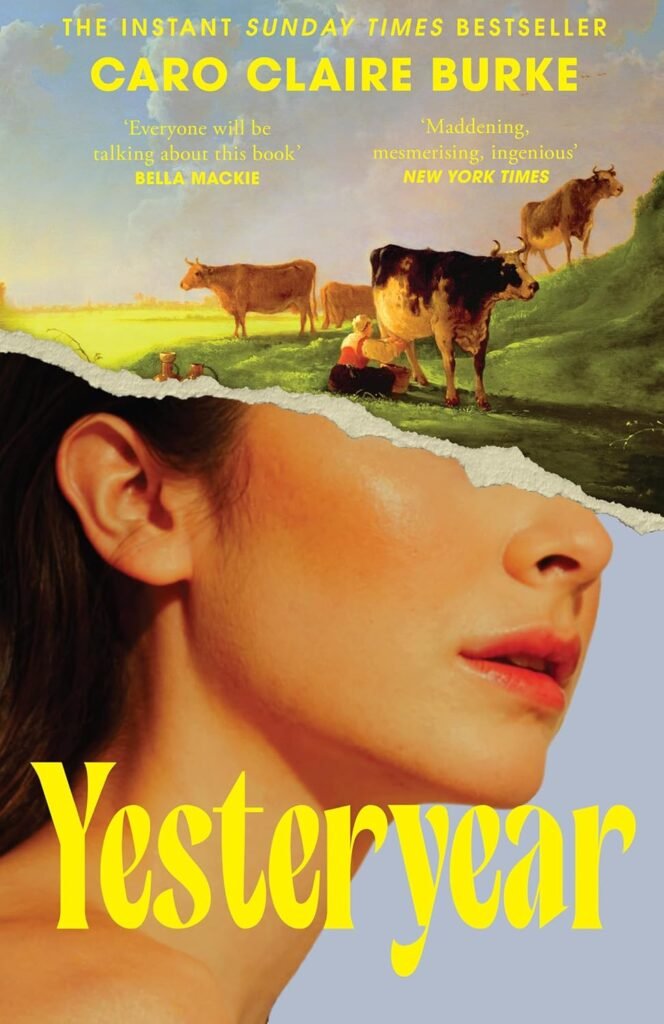
Caro Claire Burke’s debut novel arrives with considerable momentum — a Sunday Times and #1 New York Times bestseller, a GMA Book Club selection, and a film adaptation already in motion with Anne Hathaway attached to star and produce. For once, the hype is not entirely unearned.
Yesteryear follows Natalie Heller Mills, a tradwife influencer whose meticulously curated online life — sourdough loaves, linen aprons, Christian domesticity performed for the camera — is quietly propped up by nannies, ring lights, and Amazon deliveries. Then, without explanation, she wakes up in 1855 and must actually live the life she has been selling. The satirical premise is sharp and timely, skewering the aestheticisation of domesticity with genuine wit, while the dual-timeline structure builds the kind of dread more commonly found in psychological thrillers.
The New York Times called the novel “maddening, mesmerising, ingenious” — three adjectives that together capture something true about Burke’s ambition and its occasionally uneven execution.
Kirkus Reviews, in a starred notice, went further, describing it as “a remarkable debut — both a book for the moment and one that will endure.” That claim feels justified in the novel’s stronger passages, where Burke forces her protagonist to reckon physically and psychologically with the hardship she has been romanticising. The satire never quite lets Natalie off the hook, and the novel is shrewder for it.
Not every critic was fully won over. Both The Guardian and Compact pointed to weaknesses in plot depth and prose, and there are moments where the thriller mechanics strain credibility and the social commentary tips toward the obvious. These are fair observations. Burke is working at the edge of her reach in places.
And yet Yesteryear is precisely the kind of debut that earns its readers’ patience. It is propulsive, intelligent, and genuinely funny in ways that feel earned rather than engineered. Burke has written something with real staying power — a novel that uses an absurdist conceit to ask quietly serious questions about authenticity, labour, and the stories women tell about themselves.