
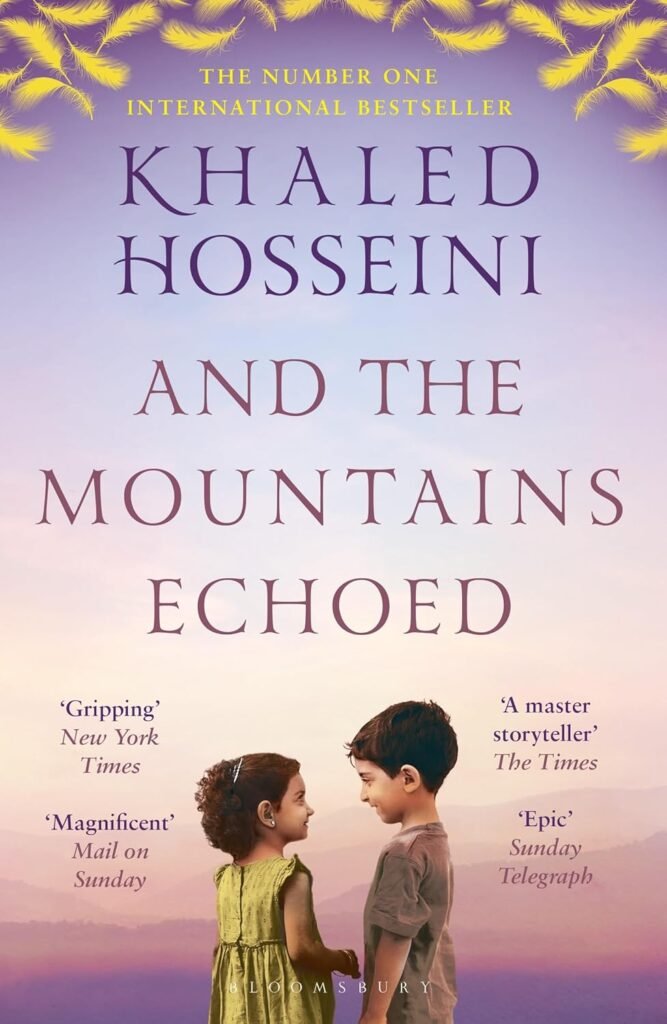
There is a Afghan proverb — unwritten, perhaps, but felt — that the land remembers what its people are forced to forget. Khaled Hosseini’s third novel operates by this logic. And the Mountains Echoed begins with a father telling his children a bedtime story, and it never quite lets go of that elemental register: the voice in the dark, the tale that wounds even as it comforts, the knowledge that some separations cannot be undone by wishing.
The novel opens in the village of Shadbagh in 1952, where a young boy named Abdullah watches his little sister Pari sold — tenderly, desperately — to a wealthy Kabul family who can offer her a life their poverty cannot. This rupture, quiet and catastrophic, is the stone dropped into still water. The nine chapters that follow trace the ripples outward across decades, borders, and generations, each narrated by a different voice: an uncle whose guilt hollows him slowly, a Greek surgeon marked by a single act of mercy, a Kabul woman who spent a lifetime loving the wrong things.
The structure is Hosseini’s most ambitious to date, and it is both the novel’s great strength and its occasional liability. The polyphonic form allows him to map the moral consequences of one act across an entire landscape of lives — what Publishers Weekly called his talent for
emotional geography
is here given its fullest canvas. Yet the very breadth that makes the novel feel epic, as the Sunday Telegraph observed, sometimes works against its depth. Certain chapters feel more fully inhabited than others, and the reader may find themselves impatient to return to voices that earned deeper trust.
What endures, however, is Hosseini’s understanding that love is rarely clean. The parents in this novel do not sell their children out of cruelty; they do it out of love, or something indistinguishable from it. The Christian Science Monitor noted the book’s moral complexity, and rightly so — there are no simple villains here, only people navigating scarcity and grief with the instruments available to them.
Michiko Kakutani, writing in the International Herald Tribune, described Hosseini as
an old-fashioned storyteller
, and there is truth in that. He writes with an unselfconscious warmth that literary fashion sometimes distrusts. But warmth, in the hands of a careful writer, is not sentimentality. It is, in fact, a form of honesty. And the Mountains Echoed — for all its structural ambitions — is ultimately a book about what we carry when we are separated from the people who made us. Afghanistan is its setting, but that ache is universal.