
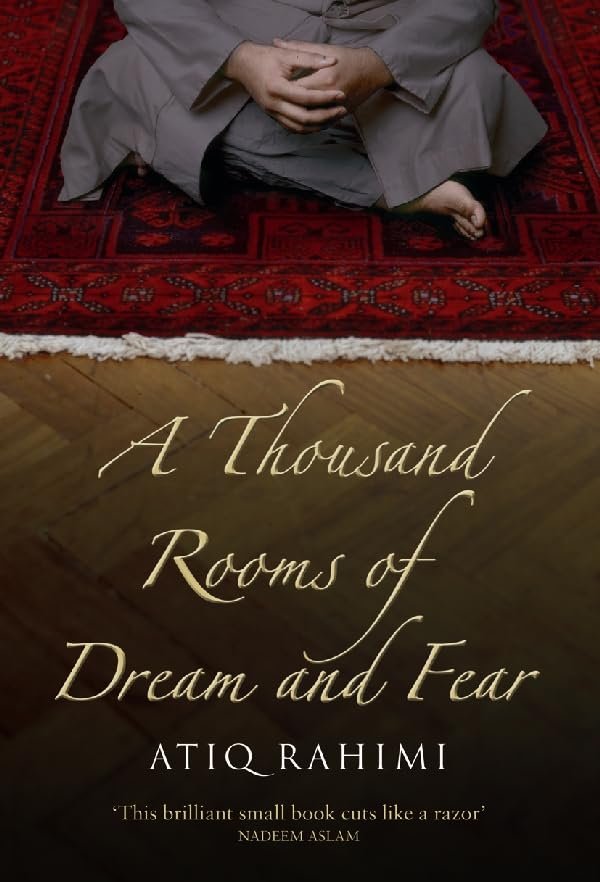
Atiq Rahimi’s A Thousand Rooms of Dream and Fear is a slender, devastating book that carries the weight of an entire nation within its spare pages. Set in Kabul on the trembling eve of the Soviet invasion in 1979, the novella follows Farhad, a young student who is beaten senseless by soldiers for breaking curfew and left to die in the street. He wakes in a stranger’s house, tended to by a mysterious woman, suspended between fever and fragile consciousness, unable to tell dream from waking, safety from danger.
Anguish Distilled
What distinguishes this book is the precision of its intensity. Rahimi writes in a mode that is simultaneously clinical and lyrical, stripping each sentence down to its barest necessity while loading it with psychological pressure. The result, as The Guardian observed, is a taut and brilliant burst of anguished prose — language that does not ornament suffering but rather enacts it. The reader inhabits Farhad’s fractured mind completely, drifting alongside him through hallucination and half-memory with no stable ground to stand on.
The intimate narrative of an entire desperate, anguished country.
That description from the Washington Post captures something essential about the book’s ambition. Farhad is not simply a wounded young man; he is a vessel for collective fear. His bruised body becomes a map of Afghanistan itself — a country caught between political terror and the desperate instinct to survive, between forbidden longing and the impossibility of freedom.
The Los Angeles Times rightly noted that the novel offers rare and uncomfortable access to the deepest fears of the people of Afghanistan, fears that are rendered here not through historical exposition but through the raw, immediate texture of one man’s feverish night. Publishers Weekly praised the English translation as flawless, a rendering that honours Rahimi’s highly calibrated style without diminishing its strangeness.
This is a book that asks to be read slowly and in silence. It rewards that attention with something close to revelation.